You could have locked in a mortgage rate below 3% in 2021 and still be paying more for your home today. A fixed rate keeps the loan portion of your payment steady, but bills like property taxes, home insurance, and utilities can still go up. Abode Money compared homeownership costs across all 50 states to see where homeowners pay the most beyond their mortgage each year and which bills drove the biggest increases.
If your own costs have gone up, knowing which bill is behind the increase can help you decide where to start, whether that's reviewing your property tax assessment or comparing home insurance quotes.
Key takeaways
- Homebuyers with 10% down pay about $8,898 a year on top of their mortgage payments, which is 33% more than the advertised payment. That covers property tax, home insurance, electricity, natural gas, and mortgage insurance.
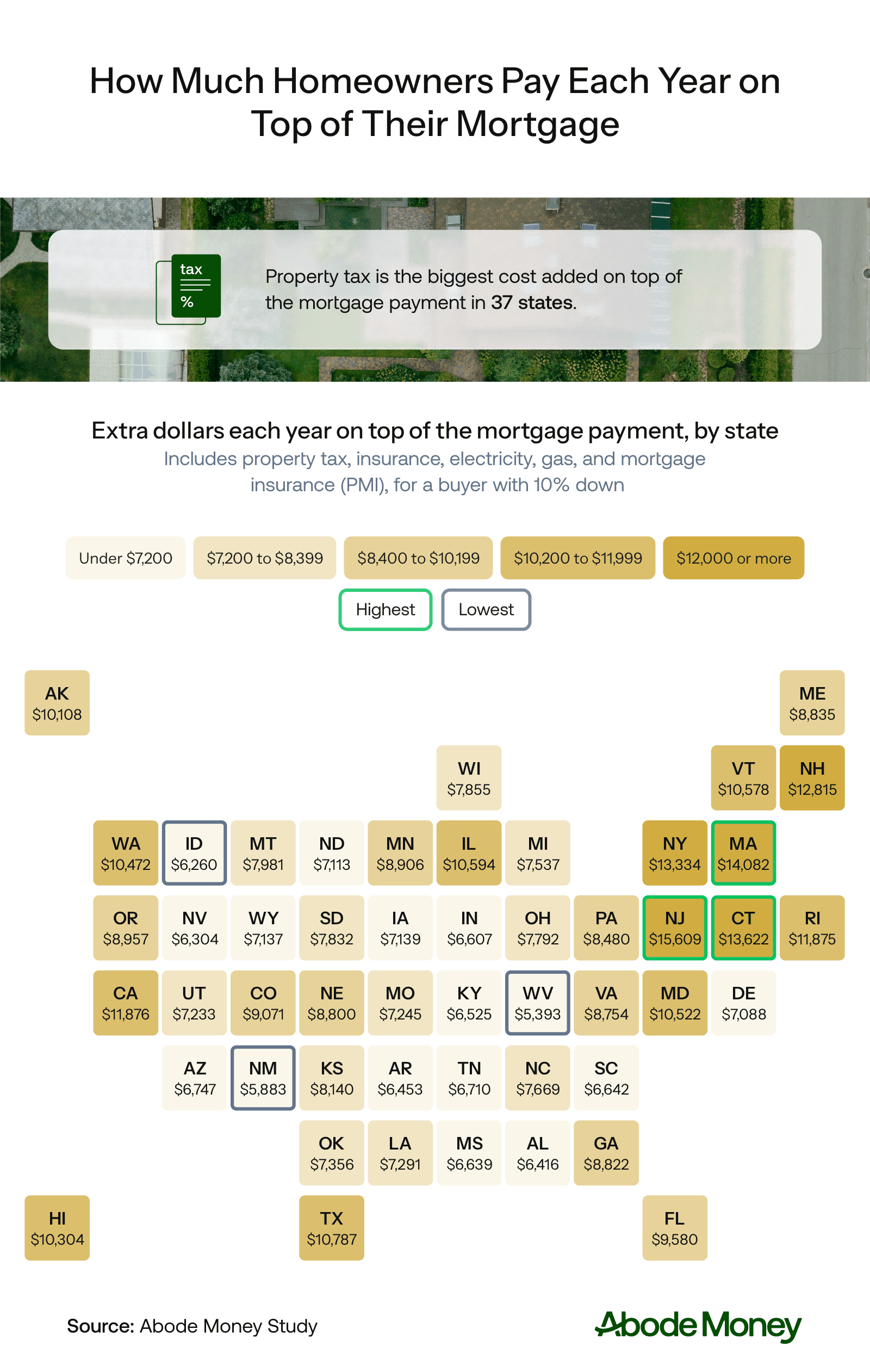
- New Jersey has the highest additional homeownership costs at $15,609 a year, followed by Massachusetts ($14,082) and Connecticut ($13,622).
- Homeownership costs have climbed an estimated $1,496 a year since 2021, even for buyers who locked in a fixed mortgage rate.
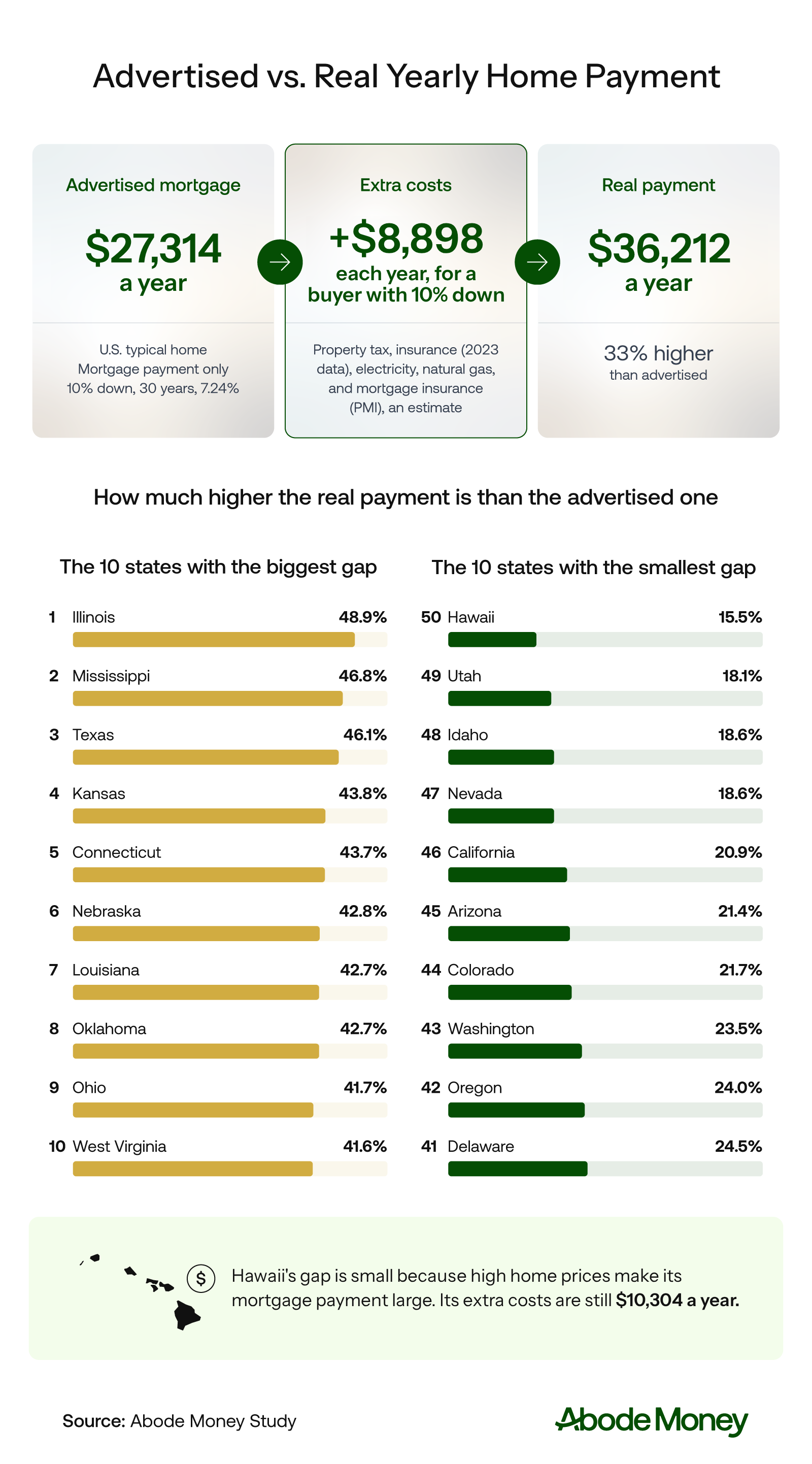
- Illinois, Mississippi, and Texas have the biggest gaps between the advertised mortgage payment and the total yearly cost, with additional expenses raising the total by 49%, 47%, and 46%, respectively.
The yearly bill beyond the mortgage
In this example, five costs add to a mortgage payment: property tax, home insurance, electricity, natural gas, and private mortgage insurance (PMI). Here's where they cost the most, and what makes up the bill.
The Northeast carries the biggest bills
- The five largest increases in bills are all in the Northeast: New Jersey, Massachusetts, Connecticut, New York, and New Hampshire.
- Property tax is the highest added cost in 37 states.
- Electricity is the highest added cost in 10 states: Alabama, Arizona, Delaware, Hawaii, Indiana, Kentucky, Mississippi, South Carolina, Tennessee, and West Virginia.
- Insurance is the highest added cost in 3 states: Arkansas, Louisiana, and Oklahoma.
Property tax and insurance are most of the bill
- Property tax and insurance account for 57% of the additional yearly bill for a buyer with 10% down.
- After New Jersey ($11,220), the highest property tax and insurance costs are in Connecticut ($8,808), New York ($8,508), Massachusetts ($8,484), and New Hampshire ($8,316). The lowest are West Virginia ($2,052), Alabama ($2,856), and Arkansas ($3,036).
- Massachusetts, Connecticut, and Texas have the highest yearly bills for home insurance, electricity, and natural gas combined, at $6,156, $5,832, and $5,784. Nevada, Utah, and Idaho have the lowest, at $2,976, $3,120, and $3,180.
Escrow, insurance, and HOA dues are all climbing
- About 65% of escrow accounts are projected to be short in 2026, with an average shortfall of about $2,100, according to Cotality. Cotality also reports that escrow costs are up about 45% in the past five years.
- The average single-family mortgage holder pays a record $2,508 a year for property insurance, which is 9.6% of the average mortgage payment, as of June 2026, according to ICE.
- Median annual HOA dues rose 44% to $757 in 2025, according to Vantaca data reported by Yahoo Finance.
Real payments run about a third above the advertised ones
In our comparison, the "advertised payment" covers the loan principal and interest. For a typical U.S. home with 10% down, we estimated that payment using Freddie Mac's average 30-year fixed mortgage rate at the time of the analysis.
The gap is widest mostly in the Midwest and South
- The real payment for a typical U.S. home is $36,212 a year, compared with an advertised payment of $27,314.
- Illinois (48.9%), Mississippi (46.8%), and Texas (46.1%) have the largest gaps between advertised and actual payments. Texas homeowners with 10% down add about $10,787 a year on top of the mortgage.
- Kansas (43.8%), Connecticut (43.7%), and Nebraska (42.8%) follow.
A wide gap doesn't always mean a big bill
- Louisiana (+$7,291), Mississippi (+$6,639), and West Virginia (+$5,393) all add less than the national average of $8,898, yet they are among the 10 states with the widest gaps. Their mortgage payments are small, so the extra costs weigh more.
- California (+$11,876) and Washington (+$10,472) add some of the biggest bills in the country, yet they are among the 10 smallest gaps. Home prices are high, so the mortgage payment is large.
- Hawaii has the smallest gap (15.5%), but its extra costs are still $10,304 a year.
Costs have grown even for homeowners with a locked-in rate
The "fixed mortgage creep" story is clearest with an example buyer. This made-up buyer bought a typical home in 2021 with 10% down and a 2.96% fixed rate, so the mortgage payment never changes.
The extra costs add $1,496 a year
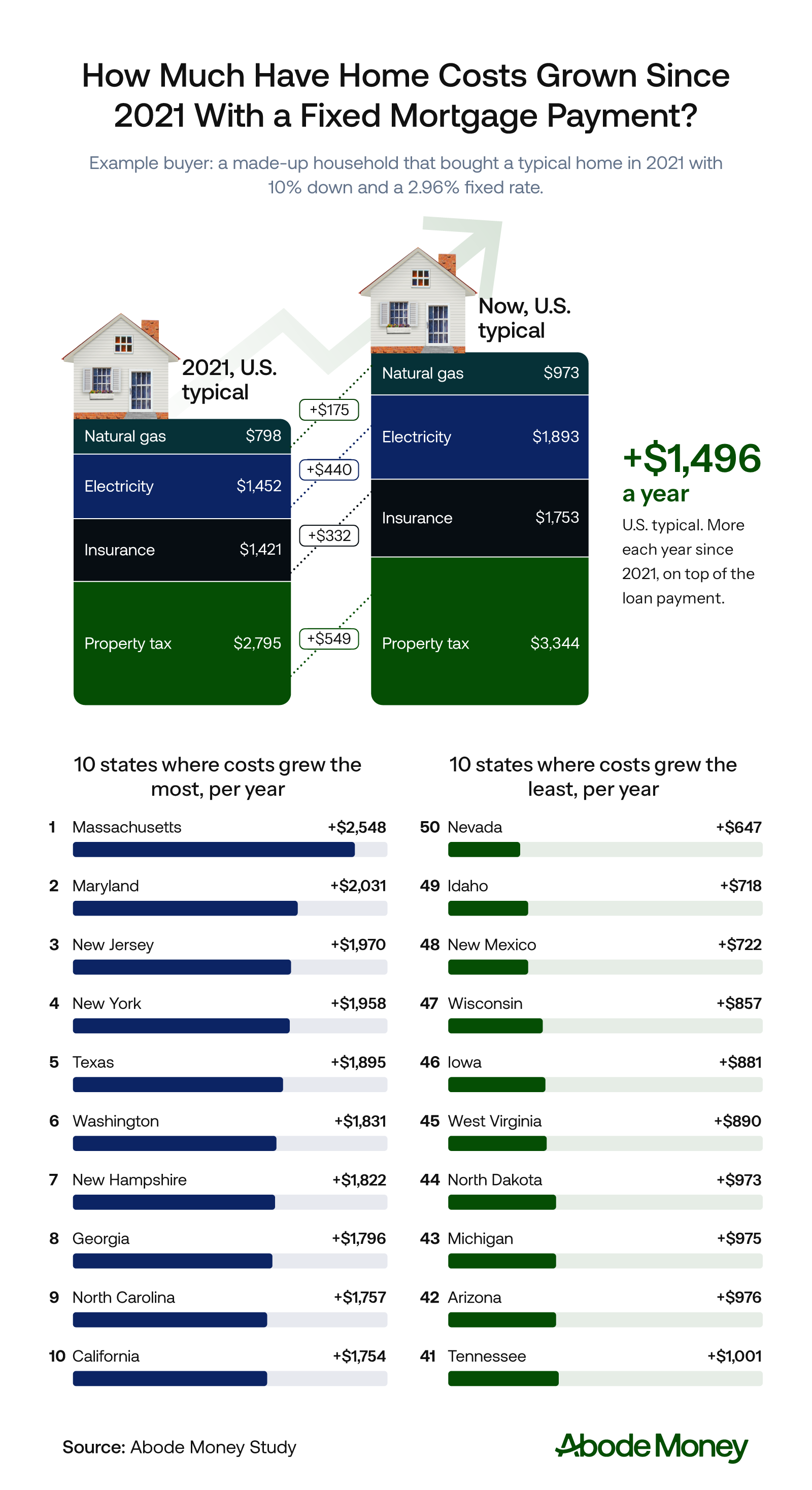
- Costs outside the fixed mortgage payment have increased by about $1,496 per year nationally since 2021.
- Those costs went from 34% of the example buyer's payment to 38%.
- Massachusetts (+$2,548), Maryland (+$2,031), and New Jersey (+$1,970) saw the biggest jumps. Nevada (+$647), Idaho (+$718), and New Mexico (+$722) saw the smallest.
What drove the rise in the top 5 states
- Massachusetts (+$2,548 total): property tax +$984, electricity +$540, natural gas +$600, insurance +$432
- Maryland (+$2,031 total): property tax +$708, electricity +$864, natural gas +$108, insurance +$336
- New Jersey (+$1,970 total): property tax +$852, electricity +$564, natural gas +$324, insurance +$228
- New York (+$1,958 total): property tax +$732, electricity +$612, natural gas +$276, insurance +$336
- Texas (+$1,895 total): property tax +$408, electricity +$540, natural gas +$264, insurance +$684
*Parts may not add to the total because of rounding.
Which cost rose the most in each state
- Property tax drove the biggest increase in 28 states, electricity in 12, insurance in 9, and natural gas in 1.
- Insurance rose the most in Colorado (+$708), Louisiana (+$696), and Texas (+$684). The insurance data ends in 2023, so this covers only 2021 to 2023.
- Electricity rose the most in Maryland (+$864), Maine (+$696), and Pennsylvania (+$696).
Start with the bill that went up
If owning your home costs more than it did last year, compare this year's property tax bill and home insurance premium with what you paid last year. If taxes drove the increase, take a closer look at the value your county assigned to your home. If that value seems high compared with recent sales of similar homes nearby, Abode Money's property tax appeal service can help you review the assessment and prepare an appeal.
Methodology
Abode Money ranked all 50 states using estimated yearly homeownership costs. We calculated each cost monthly, then multiplied by 12 to show yearly totals. The analysis assumes a buyer purchases a home at the state's median value, puts 10% down, and has a credit score of 760 or higher.
Mortgage payment and total yearly cost
We use "advertised payment" to refer to the principal and interest. We calculated it using a 30-year fixed mortgage at 7.24%, Freddie Mac's average rate for the week of October 29, 2026. For a typical U.S. home, that came to $2,276 a month, or $27,314 a year. We then added the following costs to estimate the total yearly cost:
- Property taxes: We used each state's median annual property tax bill from the Census Bureau 2025 American Community Survey (table B25103). Median home values come from the same survey (table B25077).
- Homeowners insurance: We used the NAIC homeowners insurance report, using each state's average annual premium. The latest year with data available for all 50 states was 2023. Individual quotes can vary based on the home and its history.
- Electricity and natural gas: We multiplied EIA residential prices from September 2025 through August 2026 (electricity, natural gas) by typical monthly use, then multiplied by 12. Gas is averaged across homes that use it. New Mexico, Oklahoma, California, Washington, and Kansas use the 2025 annual gas price, because the 12-month price covered less than 90% of their yearly gas use.
- Private mortgage insurance (PMI): an illustrative estimate from the National MI rate card. The card's yearly rate for a buyer with 10% down is applied to the loan. Buyers with 20% down pay no PMI.
How we measured changes since 2021
We built an example buyer who bought at the 2021 median home value with 10% down and a 2.96% fixed mortgage rate, Freddie Mac's average for that year. We held the principal and interest payment steady. We then compared property taxes, homeowners insurance, electricity, and natural gas in 2021 with the latest available figures for each, using the same calculation methods for both periods.
About Abode Money
Abode Money helps homeowners check their property tax assessments, look for missed exemptions, and prepare property tax appeals. Our home insurance service can also compare quotes before your policy renews.
Fair use statement
If you share findings or graphics from this study, please credit Abode Money and link back to this article.